Specification
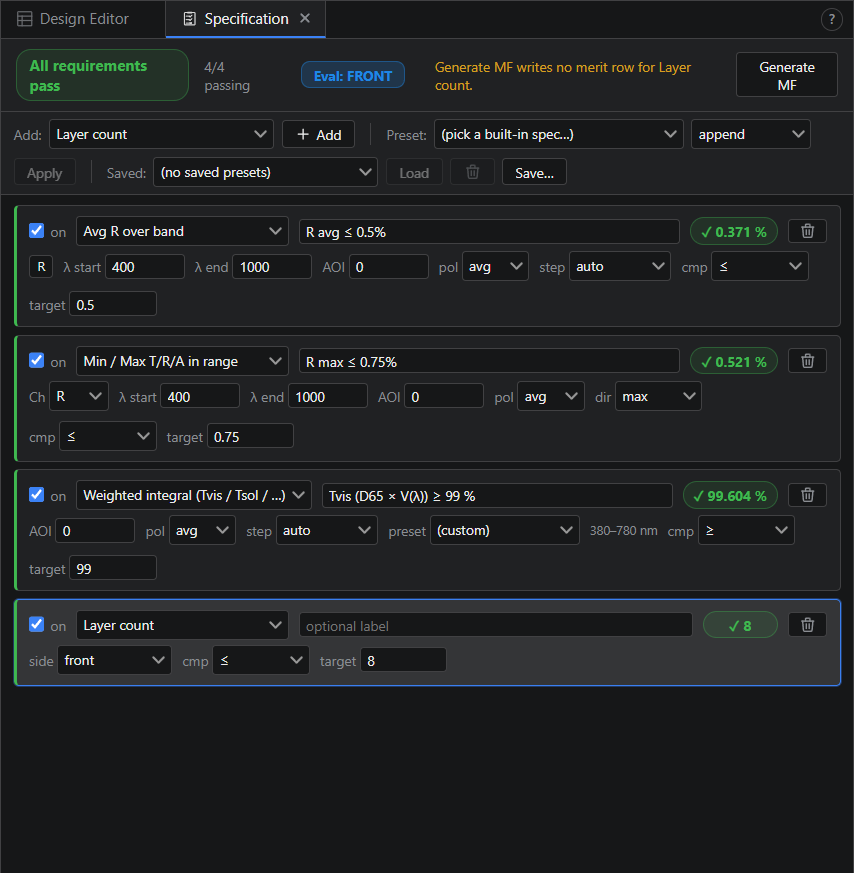
The Specification holds what the coating must meet, as pass/fail checks such as “ averaged over 450–650 nm” or “no more than 30 layers”. It is the requirement sheet, kept apart from the merit function the optimizers minimize; Generate MF turns the sheet into a merit function so a run aims at exactly what was specified. The checks are saved with the design.
Computed quantities
Section titled “Computed quantities”Each row shows the value it reads on the design beside its target, and a green tick or red cross; a failing row adds a line saying why. The banner turns green only when every row that is on passes, and counts how many do.
| Kind | Reads | Unit |
|---|---|---|
| T / R / A at λ | The channel at one wavelength. | % |
| Avg T / R / A over band | The channel averaged over a band. | % |
| Min / Max | The lowest or highest value of the channel in a band, so a narrow spike inside a good average still fails. | % |
| Weighted integral | The channel weighted by a source and a detector, such as Tvis or Tsol. | % |
| Central λ | The wavelength of the peak or notch in a band. | nm |
| FWHM | The width of the peak or notch at a level, half of the peak by default. | nm |
| Edge λ | Where the channel crosses the level on one side of the peak: the edge of a long-pass or short-pass filter. | nm |
| Total thickness | Physical thickness of the front, the back or both. | nm |
| Layer count | Layers on the front, the back or both. | count |
| Peak-to-peak error vs curve | The spread of the design’s error against a measured T, R or A curve, the figure a gain-flattening filter is specified by. | dB |
A value faded and marked ≈ is read at the default step while the value at the check’s own step is worked out. During an optimizer run the window stays at the default steps until the run stops.
Controls and settings
Section titled “Controls and settings”Each row shows only the fields its kind uses: Ch, the wavelength or λ start and λ end, AOI, pol, and for a peak dir (max or min). FWHM and Edge λ add level, a fraction of the peak between 0 and 1, and Edge λ the edge side, left or right of the peak. cmp is ≥, ≤, = ± tol, or between lo and hi.
step: how finely a check searches or samples its band.
- On a peak (Min / Max, Central λ): the search step, 1 nm by default, down to 0.001 nm. Two peaks closer than about two steps can read as one. A check on a dip searches the design’s fringes and has no step.
- On a band average or integral: auto takes the grid from the design’s fringes, no more than 2 nm apart (sampling a band), which can step over a narrow pass band; a set step is the grid exactly.
- On FWHM and Edge λ: the scan step, 1 nm by default, never fewer than 301 samples across the band. Each crossing is found exactly between samples, so the step decides only which peak is found and whether a narrow feature next to it is seen.
The same step holds wherever the check is read: the report, the Coating Library, the Monte Carlo yield and the tolerance windows’ badge. A fine step over a wide band is slow in all of them and in every optimizer run: at 0.01 nm a check over a few hundred nanometres takes a fraction of a second, at 0.001 nm several seconds.
side: what a thickness or layer count adds up, the front, the back (the mirrored front on a symmetric design) or both.
curve: the peak-to-peak check reads one of the design’s measured curves at its own points and conditions instead of a band.
Env: on a design with more than one environment, All judges the check in every environment that is on, and a numbered one judges it there alone while it is on. A check passes when it passes in each. Rows show their value in the current environment and a dash where they are not judged; the banner counts every environment that is on and names where a failing check fails. Deleting an environment deletes the checks judged in it alone.
Preset: built-in sheets for common coatings, replace or append. Save… keeps the list as your own preset under Documents\TFStudio\Qualifiers, loaded from Saved. Presets carry no environment.
Generate MF
Section titled “Generate MF”Generate MF replaces the design’s merit function, as one undo step. Each check becomes a measurement row at weight 0 and the rows that hold it to the target: OPGT for ≥, OPLT for ≤, and the pair at lo and hi for a range or at target ± tol for an equality. The merit function is then met exactly when the check passes, and a run stops at the edge of a tolerance rather than its centre. An equality with no tolerance becomes the measurement row at its target, except on Min / Max and peak-to-peak, whose row scores one side only and so gets the pair. Every row carries its check’s step and environment.
- A Total thickness on the coating the optimizers move becomes a
TTrow, or aTTminimum and maximum for a range. - A peak-to-peak check writes its curve as a block at weight 0, a
PPEFrow against it and the comparison rows (curves). - FWHM, Edge λ, Layer count, a thickness on another side and a peak-to-peak check whose curve is not on the design write nothing; a note beside the button names them.
Theory
Section titled “Theory”With the channel as a fraction, a band average and an integral read
over the band, with the source and the detector of the integral. FWHM and Edge λ start from the peak found as Central λ finds it, with value . For level the crossing value is
where and are the first wavelengths either side of at which reaches , each found by bisection between scan samples. Edge λ is or . is held between 0.001 and 0.999, since a level of 0 or 1 has no crossing.
References
Section titled “References”- H. A. Macleod, Thin-Film Optical Filters, 5th ed., Chapter 7, p. 213 and Chapter 8, p. 251: edge filters and band-pass filters, their edges and halfwidths.