Structural Optimizer
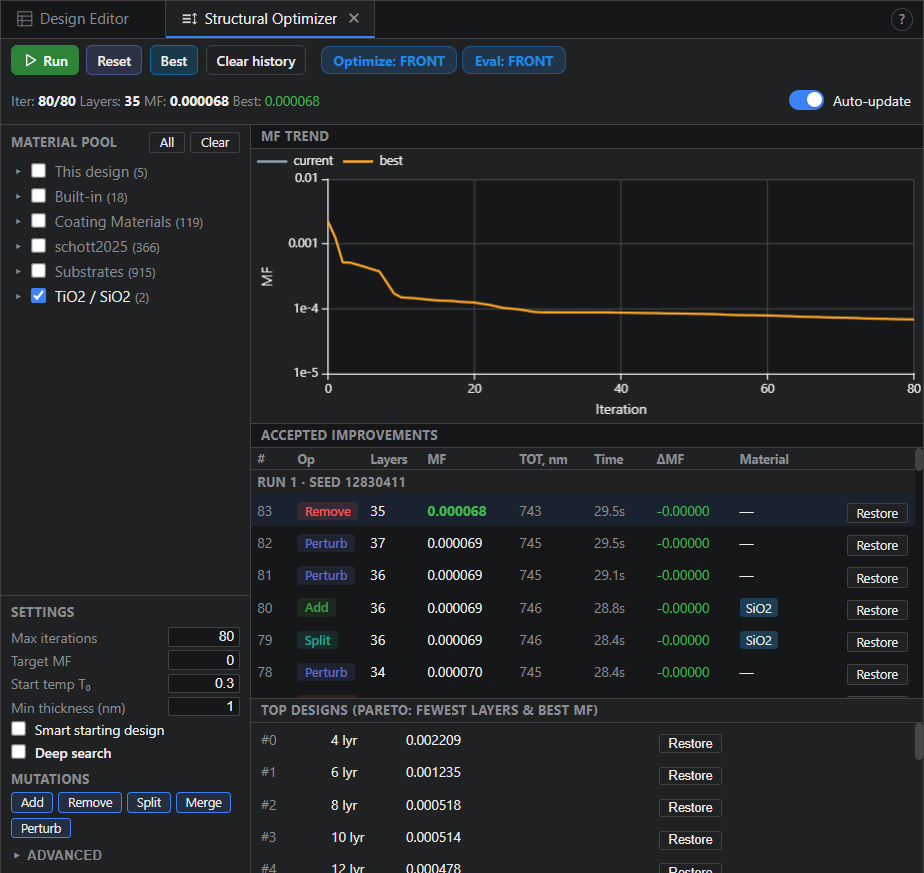
The Structural Optimizer changes the structure of a design: it adds, removes, splits, merges or perturbs layers, refines each changed design and picks the one to carry on from with a simulated-annealing rule. A worse design can be taken too, with a chance that shrinks as the run cools, and that is what lets it leave a local minimum. Because it can change the number and order of layers, it reaches designs that Refinement, which keeps the structure, and Needle and Gradual Evolution, which only add layers, may not. The design on screen is always the best one found.
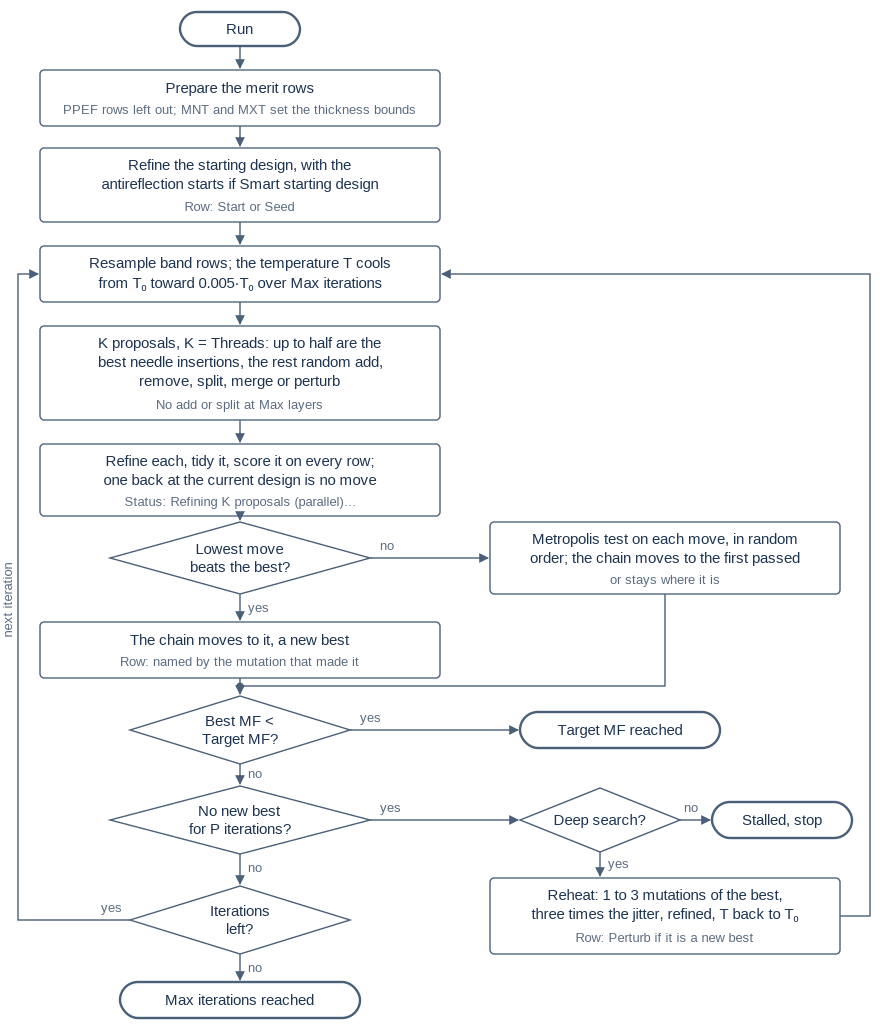
A needle insertion comes from the needle scan of the current design and goes in at the thickness the line search of Needle gives it. Locked layers are never touched, and a run with nothing left to propose ends.
Computed quantities
Section titled “Computed quantities”- MF and OMF: as in Needle. Each proposal is scored on every row,
MNTandMXTincluded. - T, Acc and Reheat on the control bar: the temperature of the accept test, the share of iterations whose move was taken, and the Deep search restarts so far.
- Op of a row in Accepted Improvements: Start or Seed, the starting design; Add, Remove, Split, Merge or Perturb, the change that made the new best, a reheat counting as Perturb. Material is the material the change added.
- ΔMF, TOT and Top Designs: as in Needle. MF Trend plots the best MF and the chain’s current MF.
Controls and settings
Section titled “Controls and settings”Run, Stop, Reset, Best, Clear history and Restore: as in Needle.
Material Pool: the materials Add and Split may use, with All / Clear; it starts and is kept the way the Needle pool is.
Mutations: which kinds of change the search may use, defined under Mutations.
Max iterations: the most iterations to run. 80 by default.
Target MF: stop once the best MF falls below this value.
Start temp T₀: the starting temperature, relative to the MF: 0.1 lets a design 10 % worse through about one time in three at the start. 0.3 by default.
Min thickness (nm): the thinnest a layer may be, for the layers the search adds, splits and refines. It starts from the strictest MNT row, or 1 nm without one, and is taken from it again when you switch designs; a note under the field shows when the two differ.
Smart starting design: start from the best of the design and the quarter- and half-wave antireflection designs built from the pool, each refined first. Off by default, since on other targets it holds the search in an antireflection design’s basin.
Deep search: when no new best has come for iterations, restart from the best design with one to three mutations at three times the jitter and the temperature back at T₀. The run then ends only at the Target MF, at the Time budget (min) or on Stop.
Synthesis refiner: the method that refines each proposal; Conjugate Gradient by default. See Optimization Methods.
Jitter (%): how far Perturb moves each thickness, as a share of it. 15 % by default.
Refine iter / step: the refinement steps each proposal gets. 60 by default.
Max added (nm): the largest thickness a randomly added layer starts at; needle insertions choose their own. 500 nm by default.
Max layers: the most unlocked layers the design may grow to. 80 by default.
Threads: how many proposals are refined together each iteration; the result depends on it. The default comes from the computer’s cores, so a run repeats on another computer only at the same Threads.
Time budget (min): with Deep search on, end after this many minutes; 0 runs until Stop.
Random seed: the mutations, the accept rolls and the reheats draw from it. Left empty, Run fills in a new seed and keeps it, so the same seed, design, settings and Threads repeat the run; the history marks each run with its seed.
The largest MNT target raises a lower Min thickness at Run, and the smallest MXT target caps every layer. A limit written for a few layers therefore applies to the whole stack here; finish with Refinement and Design Cleaner to hold each limit on its own layers.
A PPEF row, and any math row that reads it, is left out as in Needle; a Refinement run afterwards brings the peak-to-peak error down.
How it is computed
Section titled “How it is computed”Merit and refinement
Section titled “Merit and refinement”Each proposal is refined on the merit rows less MNT and MXT, with every thickness between the floor and the ceiling those rows set, then tidied (neighbours of one material merged) and scored on every row, MNT and MXT included. That score is the MF the accept test and the history use. The needle insertions use the needle function and the starting-thickness search of Needle, at the sixteen points inside each layer that Needle scans, kept at the minima along the layer.
Annealing
Section titled “Annealing”is Max iterations. With Deep search, counts from the last reheat and . The accept test uses the relative rise of the MF, so means the same on a design whose MF is as on one whose MF is 1.
Mutations
Section titled “Mutations”Every thickness is then clamped to . A kind that cannot apply, such as a merge on a single layer, gives way to another kind drawn from the rest.
Kirkpatrick et al. accept on the absolute rise of the cost. Here it is the relative rise, because merit values differ by orders of magnitude between problems. For a batch of moves refined side by side, testing each in random order and taking the first that passes is the synchronous parallel annealing rule given by Delamarre and Virot, which Ferrero et al. show is equivalent to a serial chain. The run adds one rule to it: a move that beats the best design so far is always taken, so a batch does not throw away a lower design it found. Deep search is basin hopping (Wales and Doye).
References
Section titled “References”- S. Kirkpatrick, C. D. Gelatt and M. P. Vecchi, Science 220, 671 (1983): simulated annealing and the Metropolis test.
- D. Delamarre and B. Virot, RAIRO Rech. Opér. 32, 43 (1998), §4.4.2: parallel simulated annealing.
- E. E. Ferrero, A. B. Kolton and M. Palassini, AIP Conf. Proc. 1610, 71 (2014): parallel annealing and the serial chain.
- D. J. Wales and J. P. K. Doye, J. Phys. Chem. A 101, 5111 (1997): basin hopping.
- A. V. Tikhonravov and M. K. Trubetskov, Appl. Opt. 51, 7319 (2012): modern design tools and a new paradigm in optical coating design.
- H. A. Macleod, Thin-Film Optical Filters, 5th ed., Chapter 3 (automatic design, simulated annealing).